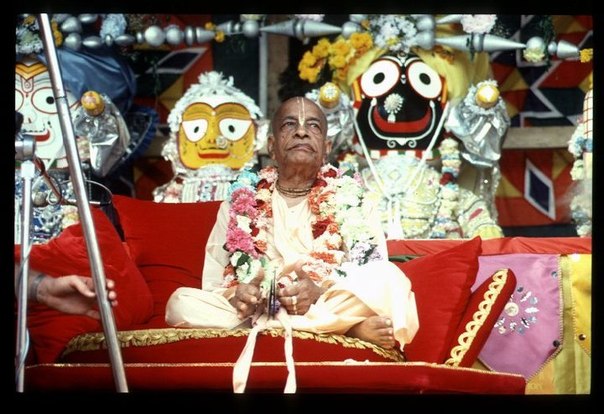
Anyone who follows the directions of Srila Prabhupada (as in his order of July 9th),
can now and into the future be accepted by Srila Prabhupada himself, as one of his disciples.
There is no need for Srila Prabhupada to accept (or reject) individual disciples now, because historical record shows that he chose to distance himself from that role and delegate it to
rtviks instead. This can be shown clearly in four events in 1977:
1. April 22, Tamal Krsna Gosvami tells Srila Prabhupada that he does not think any of Srila Prabhupada’s disciples are qualified at the level of guru, and Srila Prabupada agrees, telling TKG that he is waiting for someone to become qualified. This contradicts any earlier evidence someone may put forward saying that he had authorized gurus. As of April 22, 1977, he had not.
Conspicuously absent is any mention by Srila Prabhupada of how he supposedly authorized everyone to be initiating guru with a private letter to Tusta Krsna swami several years earlier.
2. On
May 28, Satsvarupa das Gosvami formally asked Srila Prabhupada how initiations were to continue after his disappearance, and he immediately replied, “
Officiating acarya…
Rtvik, yes.” As if unsatisfied with this, his disciples brought the conversation around to discussion of gurus, and Srila Prabhupada emphasized it would be upon his order, an order that apparently was never given.
3.
Srila Prabhupada signed a document dated
July 9, 1977, indicating that the rtviks listed therein were to act on his behalf in accepting disciples, which would then be Srila Prabhupada’s disciples. (TKG mentioned on at Topanga Canyon on Dec. 3, 1980, that Srila Prabhupada told him more rtviks could be added.) With this document, Srila Prabhupada materially
removed himself from the decision-making process in accepting disciples, having already clearly established his standard of 16 rounds, 4 regs, etc. Nowhere in this document is there any termination clause or any other contradiction of Srila Prabhupada’s prior expressed choice to employ the rtvik method for accepting disciples in ISKCON after his disappearance.
4. That Srila Prabhupada dismissed himself from the decision of accepting disciples was confirmed on October 18, when the desire of one man to become his disciple was presented to Srila Prabhupada, and Srila Prabhupada referred five times to the “deputies” he had made to go to instead. Reading the conversation gives me the impression that he was a little annoyed at being bothered to verbally accept a disciple when he had already delegated that role.
Leaving aside other supporting evidence for the sake of time and space, these four events clearly illustrate the relevant decision that Srila Prabhupada actually made, to continue accepting disciples after his disappearance via the rtvik method he instituted. Therefore it is far better to focus on honoring Srila Prabhupada’s expressed order rather than worrying that someone might wrongly accept a disciple on his behalf and force Srila Prabhupada to save another soul and deliver another devotee to Krishna against his will. Yeah, it sounds ridiculous. Have we forgotten Srila Prabhupada’s mercy?
The way Mahavidya presented it, one unaware might think Srila Prabhupada was big on rejecting his aspiring disciples. We know he accepted several thousand, including some who were just passing through and many whom he never met. How many did he reject? Mahavidya acts as if he knows of one but yet calls him a disciple, so that suggests Srila Prabhupada accepted him too. I would like to know what, if any, evidence anyone has to suggest that Srila Prabhupada would reject an aspiring disciple who would meet the criteria for initiation that he established for ISKCON. In the absence of such evidence, I find it extremely mislead for anyone to stand in the way of aspiring disciples wanting to take shelter at Srila Prabhupada’s lotus feet.
Some, including Mahavidya Prabhu recently if I recall correctly, have presented an argument they seem to find very clever, that if we can be initiated as Srila Prabhupada’s disciples even now, then that means we could just as well be initiated as disciples of any past acarya. They say, devoid of logic, that the rtvik system is invalid because I could become the godbrother of Krishna’s spiritual master, for example. This again ignores the fact that Srila Prabhupada created a worldwide institution and a rtvik method within that institution for accepting disciples in his absence, and he said this was the method to be used after his disappearance. The previous acaryas came in a different time, place, and circumstance, and did not do that. History shows that Srila Prabhupada did.
Others present the idea that somehow a guru cannot accept disciples after his disappearance. I’m not sure whether they think this is a limitation on Krishna’s abilities, on the guru’s, or both.
Considering that an ordinary rich person can give his material wealth after his disappearance to someone he has never met but who meets certain qualifications, I find it impossible to believe that on the spiritual platform a guru cannot give his spiritual wealth in an equivalent situation. Materially, it happens every day. Someone has loads of money and establishes a foundation, with funding, trustees, criteria for awards, etc., and money is given as designated, even after the founder’s death. Srila Prabhupada’s establishment of the
rtvik system in ISKCON during his manifest pastimes provides a similar infrastructure, making that system possible even now.
Given that Srila Prabhupada provided the means for accepting disciples after his disappearance, directly said to utilize the rtvik method after his disappearance, widely promulgated a written order following that, referred to the same in later
conversations and letters, and never subsequently contradicting this order… if the “walks like a duck, quacks like a duck” logic is good for anything, then rtvik system is undoubtedly what Srila Prabhupada wanted to do.
Therefore one should accept the decisions Srila Prabhupada made rather than falsely accusing others of stealing from Srila Prabhupada a decision that he formally delegated. Hare Krishna
——
COMMENT BY COREY
One question for Krsna dasa: Since, according to you, we can’t have Srila Prabhupada as our guru, then WHO are we supposed to take shelter of? Who is your guru, Krsna dasa?
Second question: Where did Srila Prabhupada ever authorize or order anyone to become diksa gurus?
He only authorize them to become ritviks. So, unless you can present evidence to the contrary, I will stick with the system of initiation that Srila Prabhupada DID IN FACT establish, the ritvik system.
Good luck finding such evidence, because according to
Tamal Krishna, it does not exist:
“
You cannot show me anything on tape or in writing where Prabhupada says: “
I appoint these eleven as gurus.” It does not exist because he never appointed any gurus. This is a myth.” – (
Tamal Krishna Goswami, December 3, 1980)
-
Four objections to the ritvik system that has been put
forth in this article. Here are some answers to such objections.
BY COREY
FIRST OBJECTION: supporters of Srila Prabhupada’s rtvik order are denying him his right to reject aspiring disciples.
ANSWER: On July 7th, when setting up the ritvik system, Srila Prabhupada states that the ritviks could accept devotees as his disciples without consulting him. Thus, Srila Prabhupada was not involved in the process of screening, or approving new disciples. The ritviks had full authority and discretion. Srila Prabhupada’s physical involvement was not required.
Srila Prabhupada: So without waiting for me, wherever you consider it is right. That will depend on discretion.
Tamal Krishna: On discretion.
Srila Prabhupada: Yes.
(Srila Prabhupada Room conversation, 7/7/77, Vrindavan)
Furthermore, the names given by the ritviks would be entered by Tamal Krishna Goswami into the “Initiated disciples” book. Thus, externally at least, Srila Prabhupada would not even have been aware of the disciple’s existence. Consequently, the process now would be the same as it was then, since the ritvik has full power of attorney.
SECOND OBJECTION: that if we can be initiated as Srila Prabhupada’s disciples even now, then that means we could just as well be initiated as disciples of any past acarya.
ANSWER: Two things prevent this from being a bona fide option:
1. Srila Bhaktisiddhanta, and other previous acaryas, did not authorise a ritvik system to run “henceforward”.
2. We must approach the current link:
“…in order to receive the real message of Srimad-Bhagavatam one should approach the current link, or spiritual master, in the chain of disciplic succession.” (S.B. 2.9.7, purport)
It is self-evident that Srila Prabhupada is the sampradaya acarya who succeeded Srila Bhaktisiddhanta. Srila Prabhupada is therefore our current link, and is thus the correct person to approach for initiation.
THIRD OBJECTION: Others present the idea that somehow a guru cannot accept disciples after his disappearance.
ANSWER: There is nothing in the July 9th Final Order letter that says the instruction for ritviks was only meant for whilst Srila Prabhupada was physically present. In fact, the only information given supports the continuation of the ritvik system after Srila Prabhupada’s departure. It is significant to note that within the July 9th letter it is stated three times that those initiated would become Srila Prabhupada’s disciples. The GBC in presenting evidence for the current guru system have argued vigorously that Srila Prabhupada had already made it clear that, as far as he was concerned, it was an inviolable law that no one could initiate in his presence. Thus the necessity to state Srila Prabhupada’s ownership of future disciples must indicate that the instruction was intended to operate during a time period when the ownership could even have been an issue, namely after his departure.
For some years Srila Prabhupada had been using representatives to chant on beads, perform the fire yajna, give gayatri mantra etc. No one had ever questioned whom such new initiates belonged to. Right at the beginning of the July 9th letter it is emphatically stated that those appointed are “representatives” of Srila Prabhupada. The only innovation this letter contained then was the formalisation of the role of the representatives; hardly something which could be confused with a direct order for them to become fully-fledged diksa gurus. Srila Prabhupada’s emphasis on disciple ownership would therefore have been completely redundant were the system to operate only in his presence, especially since as long as he was present he could personally ensure that no one claimed false ownership of the disciples. As mentioned above, this point is hammered home three times in a letter which itself was quite short and to the point:
“So as soon as one thing is three times stressed, that means final.” (Srila Prabhupada Bg. Lecture, 27/11/68, Los Angeles)
The July 9th letter states that the names of newly initiated disciples were to be sent “to Srila Prabhupada” – Could this indicate that the system was only to run while Srila Prabhupada was physically present? Some devotees have argued that since we can no longer send these names to Srila Prabhupada, the ritvik system must therefore be invalid.
The first point to note is the stated purpose behind the names being sent to Srila Prabhupada, ie., so they could be included in his “Initiated Disciples” book. We know from the July 7th conversation (please see Appendices) that Srila Prabhupada had nothing to do with entering the new names into this book, it was done by his secretary. Further evidence that the names should be sent for inclusion in the book, and NOT specifically to Srila Prabhupada is given in the letter written to Hamsadutta, the very next day, where Tamala Krishna Goswami explains his new ritvik duties to him:
“…you should send their names to be included in Srila Prabhupada’s ‘Initiated Disciples’ book.” (Letter to Hamsadutta from Tamala Krishna Goswami, 10/7/77)
Their is no mention made here of needing to send the names to Srila Prabhupada. This procedure could easily have continued after Srila Prabhupada’s physical departure. Nowhere in the final order does it state that if the “Initiated Disciples” book becomes physically separated from Srila Prabhupada all initiations must be suspended.
The next point is that the procedure of sending the names of newly initiated disciples to Srila Prabhupada in any case relates to a post-initiation activity. The names could only be sent after the disciples had already been initiated. Thus an instruction concerning what is to be done after initiation cannot be used to amend or in any way interrupt pre-initiation, or indeed initiation procedures (the ritvik’s role being already fulfilled well before the actual initiation ceremony takes place). Whether or not names can be sent to Srila Prabhupada has no bearing on the system for initiation, since at the point where new names are ready to be sent, the initiation has already occurred.
The last point is that if sending the names to Srila Prabhupada were a vital part of the ceremony, then even before Srila Prabhupada’s departure, the system would have been invalid, or at least run the constant risk of being so. It was generally understood that Srila Prabhupada was ready to leave at any time, thus the danger of not having anywhere to send the names was present from day one of the order being issued. In other words, taking the possible scenario that Srila Prabhupada leaves the planet the day after a disciple has been initiated through the ritvik system, according to the above proposition, the disciple would not actually have been initiated simply because of the speed by which mail is delivered. We find no mention in Srila Prabhupada’s books that the transcendental process of diksa, which may take many lifetimes to complete, can be obstructed by the vicissitudes of the postal service. Certainly there would be nothing preventing the names of new initiates being entered into His Divine Grace’s “Initiated Disciples” book even now. This book could then be offered to Srila Prabhupada at a fitting time.
FOURTH OBJECTION: It is absolutely clear that Srila Prabhupada wanted the disciplic succession to continue and not terminate with him.
ANSWER: The disciplic succession, or guru parampara, is eternal; there is no question of it stopping. According to Srila Prabhupada, the Sankirtan Movement, (and hence ISKCON), will only exist for the next 9,500 years. Compared with eternity 9,500 years is nothing, a mere blip in cosmic time. This would appear to be the time period during which Srila Prabhupada shall remain the “current link” within ISKCON, unless he or Krishna countermands the July 9th order, or some external circumstance renders the order impossible to follow (such as total thermo-nuclear annihilation).
Previous acaryas have remained current for long periods of time, thousands (Srila Vyasadeva) or even millions of years (see quote below). We see no reason why the duration of Srila Prabhupada’s reign as “current link”, even if it extends right till the end of the Sankirtan Movement, should pose any particular problem.
“Regarding Parampara System: there is nothing to wonder for big gaps [...] we find in the Bhagavad-gita that the Gita was taught to the sungod, some millions of years ago, but Krishna has mentioned only three names in this parampara system – namely, Vivasvan, Manu, and Iksvaku; and so these gaps do not hamperfrom understanding the parampara system. We have to pick up the prominent acaryas, and follow from him [...] We have to pick up from the authority of the acarya in whatever sampradaya we belong to.” (Srila Prabhupada Letter to Dayananda, 12/4/68)
Gaps in the Disciplic Succession: Regarding your third question—”Why are there apparent time‐gaps in the line of disciplic succession as listed in the Bhagavad‐gita? Is Arjuna an instructor Spiritual Master and not an initiator Spiritual Master and therefore not listed?” The time gap mentioned by you is inevitable, because the disciplic succession sometimes becomes disconnected, as we find from the Bhagavad‐gita. This is the influence of material energy, and to link it up again, it takes some time. That some time may appear to our calculation a big gap, but in relation with the eternal time, it is not even as instant. So this big gap or small gap of time is relative. Just like our 24 hours and Brahma’s 24 hours, there is much difference. Our 24 hours is not even a fraction of his second….” (Srila Prabhupada Letter to Rupanuga Hawaii 14 March, 1969)
Disciplic Succession does not always mean that one has to be initiated officially
Regarding the disciplic succession coming from Arjuna, disciplic succession does not always mean that one has to be initiated officially. Disciplic succession means to accept the disciplic conclusion. Arjuna was a disciple of Krishna and Brahma was also a disciple of Krishna. Thus there is no disagreement between the conclusions of Brahma and Arjuna. Vyasadeva is in the disciplic succession of Brahma. The teachings to Arjuna was recorded by Vyasadeva verbatim. So according to the axiomatic truth, things equal to one another are equal to each other. We are not exactly directly from Vyasadeva, but our Gurudeva is a representative of Vyasadeva. Because Vyasadeva and Arjuna are of equal status, being students of Krishna, therefore we are in the disciplic succession of Arjuna. Things equal to the same thing are equal to one another. (Srila Prabhupada letter to Dinesh Tittenhurst 31 October, 1969)
The
July 9th order is significant since it means that
Srila Prabhupada shall be the Prominent Acarya, at least for members of ISKCON, for as long as the Society exists. Only the direct intervention of Srila Prabhupada or Krishna can revoke the final order (such intervention needing to be at least as clear and unequivocal as a signed directive sent to the entire Society). Thus until some counter-instruction is given, the science of devotional service shall continue to be transmitted directly by Srila Prabhupada to successive generations of his disciples. Since this is a common phenomenon in our disciplic succession, there is no cause for alarm. The succession can only be considered “ended” if this science of devotional service is lost. On such occasions, Lord Krishna Himself usually descends to re-establish the principles of religion. As long as Srila Prabhupada’s books are in circulation, this “science” shall remain vigorously intact, and perfectly accessible.